

Introduction: Americans Driving in Spain in 2026
Spain offers some of Europe’s most rewarding road trips—from the white villages of Andalusia to the dramatic coastline of Costa Brava, the vineyards of Basque Country, and the volcanic landscapes of the Canary Islands. For Americans planning to explore beyond major cities, renting a car opens up experiences that trains and buses simply cannot match.
The good news: American drivers can legally drive in Spain with a valid US license paired with an International Driving Permit for short-term visits. Tourists staying under 90 days within the Schengen Area generally fall into this category. However, long-term residents or expats staying more than six months in Spain or the EU must obtain a Spanish driver’s license through a full testing process—there’s no simple exchange available for US licenses.
Spain drives on the right hand side, same as the United States, but enforcement on speed limits, alcohol, and mobile phone use is considerably stricter. Speed cameras blanket highways, and police conduct random breath tests, particularly on weekends.
International Automobile Authority (IAA) offers US drivers a fast way to secure an international driving permit online—typically completed in just 5 minutes before departure.
Can You Drive in Spain with a US License in 2026?
Yes, Americans can drive in Spain with a US license, but the rules differ significantly for tourists versus residents.
US tourists visiting Spain for up to 90 days can generally drive with a valid US license. However, Spanish authorities—including the Guardia Civil Tráfico—expect you to carry an international driving permit or official Spanish translation alongside your US license. Many police officers and rental car desks will ask for this documentation, and fines of €90–€200 can be issued if you cannot provide an official translation.
Long-term residents holding work, study, or non-lucrative visas face different requirements. If you stay more than six months in Spain or the EU (counting from your initial entry point), your US license plus IDP is only valid up to that threshold. After that, you must obtain a Spanish driver’s license through the entire process of theory and practical testing.
During a police officer stop, expect requests for: your US driver’s license, IDP, passport, and rental or ownership documents. Expat forums report cases where Americans received fines up to €500 for driving on expired foreign permits after residency status activated.
[IMAGE: close-up of a US driver’s license and an International Driving Permit on the dashboard, with a Spanish “Guardia Civil Tráfico” patrol car blurred in the background]
International Driving Permit (IDP) for Americans in Spain
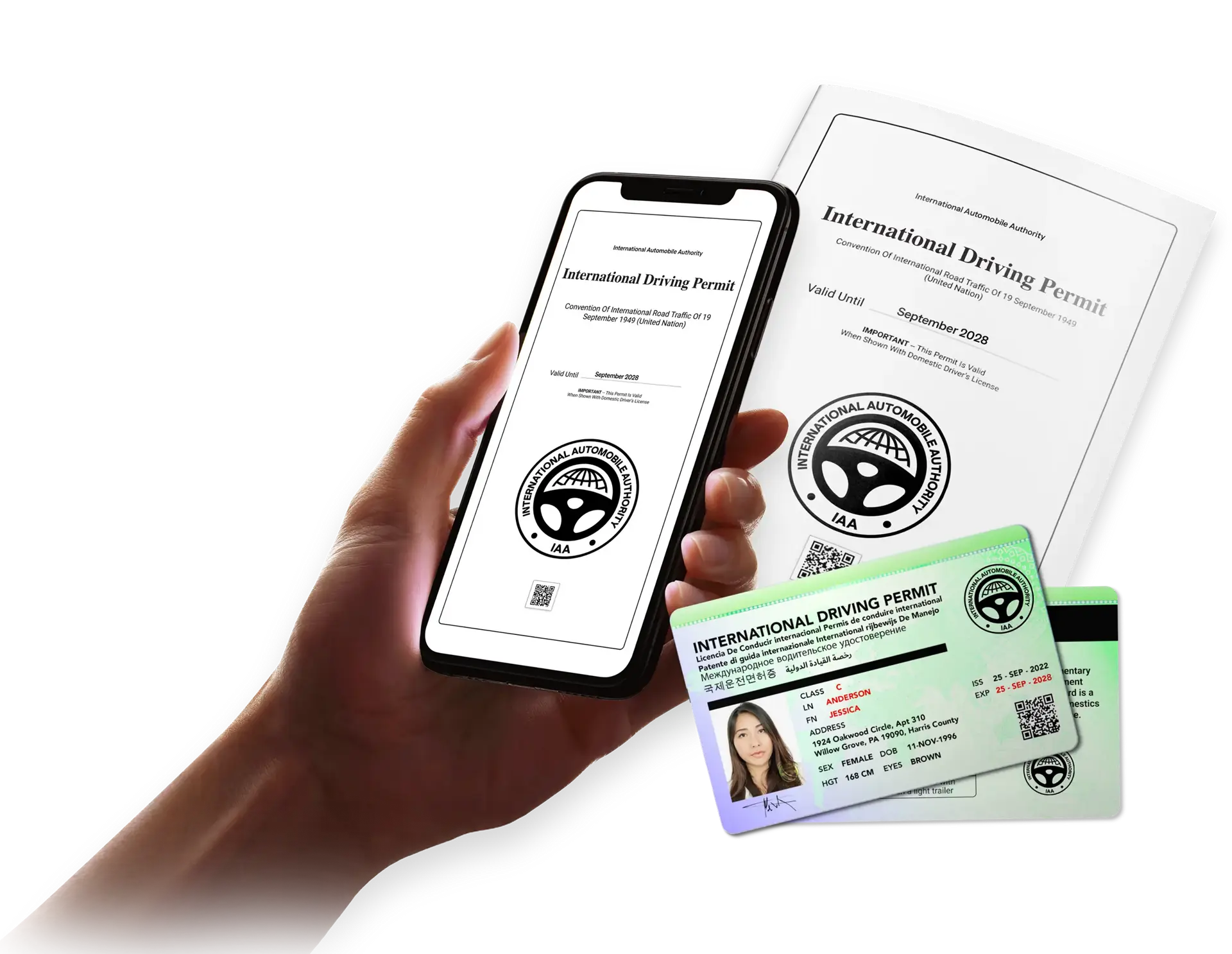
An international driver’s permit is not a standalone driving license. It’s an official multi-language translation booklet based on the UN 1949 Geneva Convention that converts your domestic license information into formats recognized internationally—including Spanish.
Why is an IDP strongly recommended in Spain? Many Guardia Civil officers and rental agency desks at airports like Madrid-Barajas or Barcelona-El Prat will reject non-translated licenses. This can result in on-the-spot fines or rental denials, leaving you stranded at the counter.
An IDP typically offers 1-, 2-, or 3-year validity options and must always be presented together with your original US license to be legally valid.
How IAA’s process works:
- Upload a passport-style photo, license scan, and digital signature
- Choose validity period (1, 2, or 3 years)
- Receive a digital IDP in 5–8 minutes for immediate printing
- Optional physical booklet and plastic card shipped same day globally
Apply 1–2 weeks before flying to Madrid or Barcelona to receive physical documents before departure. For last-minute travelers, digital delivery is nearly instant. Your IDP can also be used across multiple Schengen countries—France, Portugal, Italy—on the same trip, as long as local tourist rules are respected.
How Americans Can Get a Spanish Driver’s License
For stays beyond six months or for residents on work, study, or non-lucrative visas, a full Spanish license process is required. Unlike some EU or Latin American drivers, Americans generally cannot exchange their license directly.
Basic eligibility requirements:
- Minimum driving age of 18
- Valid residence permit (NIE)
- Registration with a local address in Spain (padrón)
The process involves enrolling in an autoescuela (driving school), completing a medical fitness exam called a psicotécnico, passing the DGT theory test, and completing a practical driving test. Many American expats report needing 3–9 months from enrollment to passing both exams due to scheduling backlogs in cities like Madrid and Barcelona.
Estimated total cost in 2026: €600–€1,200 depending on city, number of driving lessons, and retakes.
Switching Your US License to a Spanish License
Spain does not have a blanket bilateral exchange agreement with the United States. This means Americans usually cannot “swap” their US license for a Spanish one—unlike drivers from other countries with reciprocal agreements.
Even if you have decades of driving experience in California, Texas, or New York, you must complete Spain’s full licensing path once you become a resident. Holders of certain residency permits are given a fixed period after obtaining residency to complete this process. After that grace period (typically six months for EU entrants), driving on a foreign license can become illegal.
New residents should start the autoescuela process soon after obtaining their NIE to avoid any legal gray period.
Driving School in Spain (Autoescuela)
An autoescuela typically offers classroom theory preparation, online practice tests, and practical lessons in dual-control vehicles. Most instruction occurs in manual transmission cars.
Typical 2026 costs:
- Enrollment fee: €200–€300
- Per-lesson cost: €25–€35 for a 45–60 minute session
- Theory and practical exam fees: approximately €90 combined
Madrid, Valencia, Barcelona, and Málaga have several schools with English support materials. Look specifically for autoescuelas offering theory content and mock exams in English, especially in expat-heavy areas.
Budget at least 20–30 practical lessons if you’re unfamiliar with manuals, Spanish roundabout rules, or dense urban areas traffic.
The Written Theory Test in Spain
The written test administered by the DGT (Dirección General de Tráfico) consists of 30 multiple-choice questions with a maximum of 3 errors allowed—a 90% passing threshold.
Complete at least 80–100 online practice tests through your autoescuela until you consistently score 90%+. In many provinces, you can request the written exam in English, but translations may be imperfect. Learning key Spanish driving terms helps: “ceda el paso” (yield), “autovía” (highway), “prohibido adelantar” (no passing).
Passing the theory test is required before booking your practical exam.
The Practical Lessons and Driving Test
The normal path includes 15–25 hours of driving lessons covering urban streets, highway conditions, roundabouts, parallel parking, and hill starts with a manual gearbox.
Important: If you take the exam in an automatic car, your license will be restricted to automatic transmission only. This can be limiting since approximately 80% of Spanish rentals are manual.
The practical exam works like this: an examiner sits in the back seat, your instructor in the front passenger seat, and you drive for roughly 25–30 minutes through mixed traffic near the testing center.
Including exam fees and typical retakes, the practical phase brings total licensing costs to €600–€1,200 for many Americans. Pass rates for foreigners hover around 60–70% on the first attempt.
Key Spanish Road Rules for Americans
Although Spain drives on the right, many rules differ significantly from US norms. Alcohol limits are stricter, right turns on red are almost never allowed, roundabouts replace many intersections, and all measurements use metric units (km/h, meters).
Many road signs use pictographic European standards, which helps non-Spanish speakers navigate effectively. However, understanding specific traffic rules prevents costly fines and dangerous situations.
[IMAGE: overhead view of a Spanish multi-lane roundabout in Valencia with visible lane markings and exit arrows]
Speed Limits and Enforcement
2026 speed limits in Spain:
Road Type | Speed Limit |
|---|---|
Built up areas | 30–50 km/h |
Rural roads | 90 km/h |
Multi-lane non-motorway | 100 km/h |
Autovías/Autopistas | 120 km/h |
Residential areas/shared zones | 20 km/h |
Speed cameras—both fixed radares fijos and mobile radares móviles—are extremely common on highways and at town entrances. Tickets are sent to rental companies, which then charge your card plus a €30 administrative fee.
Fines range from €100 for minor speeding up to €600+ for serious violations with potential points deduction. Navigation apps with speed limit displays and camera alerts help, but your mobile phone must be mounted and used completely hands-free.
Traffic Lights and Right Turns on Red
Right turn on red is almost never allowed in Spain unless a specific green arrow signal permits it. A red light always means a complete stop—no exceptions.
Many traffic lights are mounted on poles at the side and overhead. Americans should look up rather than only forward at the far side of the intersection. Major cities like Madrid, Seville, and Valencia have numerous pedestrian crossings where you must yield to pedestrians even when you have green.
Blocking crosswalks is heavily fined and considered dangerous. Stop behind the line, not on it.
Roundabouts (Rotondas)
Roundabouts are far more common than four-way stops throughout Spain, especially on city outskirts and in suburban areas. Valencia alone has thousands.
Key roundabout rules:
- Vehicles already inside the roundabout have priority
- Use the inside lane for later exits, outside lane for first or second exit
- Always signal when exiting
- Enter the inner lane, stay until just past the exit before yours, then signal right and move to the outer lane
Spanish drivers may honk if you hesitate, but prioritize safety over speed. Ensure you’re in the correct lane before attempting to exit.
Alcohol, Mobile Phones, and Safety Equipment
Spain enforces strict alcohol limits:
- 0.05% BAC for most drivers
- 0.03% BAC for new drivers (under 2 years licensed) and professionals
This is stricter than many US states. Police conduct random breath tests on weekends and during major holidays like Semana Santa and August vacation season.
Handheld phone use while driving is illegal. Only fully hands-free systems are permitted—even touching your device can result in fines of approximately €200 and points on a Spanish license. Use Google Maps with voice navigation and a mounted holder.
Spanish law requires reflective vests and warning triangles in the vehicle. V16 beacons are phasing in by 2026. Rental cars usually provide required safety equipment, but verify everything is present at pickup.
Seat Belts and Child Seats
Seat belts are compulsory for all occupants—front seat and rear—at all times. Fines run approximately €90 per person for non-compliance.
Children under 135 cm (roughly 4 ft 5 in) must use approved child restraint systems and typically sit in rear seats. Reserve child seats with the rental company in advance, especially during peak school holidays (June–August, Christmas, Easter).
US-standard car seats may not meet EU approval labels. Using seats supplied or certified for EU use is both safest and most legally sound.
Renting a Car in Spain as an American
Renting a car is ideal for exploring Andalusian white villages, La Rioja wine country, Asturias coastline, mountain roads in the Pyrenees, and smaller cities off the train routes. For city-to-city travel between Madrid, Barcelona, and Valencia, trains remain faster.
Essential rental requirements:
- Minimum age: usually 21, sometimes 23 or 25
- Young driver surcharge: €20–€50/day for drivers under 25
- Required documents: passport, US driver’s license, IDP, credit card in driver’s name
Book automatic transmission cars well in advance—they’re 20–50% pricier and scarce at smaller airports like Granada or Santiago de Compostela.
Insurance and Deposit Requirements
Common coverage types in Spain:
Coverage Type | Description |
|---|---|
Third-party liability | Required by law |
CDW/LDW | Covers collision/damage (€15–€25/day) |
Theft protection | Covers vehicle theft |
Super CDW | Reduces/eliminates deductible |
Standard deductibles can be €1,000–€2,000, blocked as a security deposit on your credit card. Some US credit cards cover rentals in Spain, but many exclude certain vehicle types or European countries entirely.
Check your card’s car insurance terms carefully before declining coverage. Wheel damage and scratches affect roughly 30% of rentals on narrow Spanish streets. Risk-averse travelers should consider full coverage to avoid surprise charges.
Practical Tips for Renting and Returning
Photograph the car thoroughly at pickup—all sides, wheels, interior, and windshield—and again at return. This documents any pre-existing damage and protects against false claims.
Choose full-to-full fuel policies whenever possible to avoid inflated refill charges. Many city centers (Madrid, Barcelona, Seville) have low-emission zones where rental cars may be restricted. Park in garages outside the old town and walk or use public transport to explore.
Plan routes avoiding tight medieval centers unless your hotel provides clear access instructions and parking spots.
Parking in Spain
Color-coded parking zones:
- Blue zones (Zona Azul): Metered parking, 1–2 hour limits, €1–€3/hour
- Green zones: Often resident-only
- Yellow/red markings: No parking or loading zones
Display your ticket from the automated machine on the dashboard in blue zones. In major cities like Barcelona, Madrid, and San Sebastián, parking is expensive and scarce. Underground car parks (€20–€30/day) or park-and-ride facilities save stress.
Illegal parking leads quickly to towing or wheel clamps, with total fines and tow yard fees running €150+. Never park in loading zones or resident areas without authorization.
Driving Conditions and Road Types in Spain
Spain’s road network spans modern high-speed highways between cities and narrow mountain passes through the Pyrenees, Picos de Europa, and Sierra Nevada.
Main road categories:
- Autopistas (AP): Toll motorways
- Autovías (A): Free high-speed roads
- National roads (N): Main non-motorway routes
- Regional/local roads (C-, MA-): Secondary routes
Most tourists use a mix of A- and AP-roads for long distances (Madrid–Valencia, Barcelona–Valencia) and smaller regional roads for exploring rural villages.
Toll Roads and Payment
Many autopistas along the Mediterranean (AP-7) and other corridors charged heavy tolls historically. While some stretches became toll-free post-2020, important segments in 2026 still charge.
The entry/exit ticket system works simply: collect a ticket when entering, pay based on distance when exiting. Payment accepted by card or cash (euros). A long toll segment between Barcelona and Valencia might cost €20–€30.
Keep some cash and at least one physical credit/debit card handy—not all toll booths accept contactless or foreign cards without chip/PIN.
Mountain and Rural Roads
Rural and mountain roads feature narrow lanes, sharp curves, limited guardrails, and slow agricultural vehicles or cyclists.
Challenging areas for American drivers:
- Pyrenees near Vielha
- Sierra Nevada above Granada
- Canary Islands (Tenerife, Gran Canaria) mountain routes
Allow extra travel time, use low gears for descents, and avoid driving at night on unfamiliar mountain roads. Watch for livestock on roads in Asturias, Cantabria, Galicia, and Basque Country. Slow down near villages with frequent pedestrian crossings.
City Driving in Madrid, Barcelona, and Other Big Cities
Driving in central Madrid, Barcelona, Seville, and Valencia involves narrow streets, complex one-way systems, bus/taxi lanes, and environmental zones. Stress levels rise quickly.
Leave the car in a paid garage and use public transport or walking to explore city centers. Both Madrid and Barcelona have extensive metro and bus networks.
Camera-enforced restricted access zones can generate automatic fines mailed to the rental company—sometimes €200+ per violation. Use navigation apps that recognize low-emission zones and verify hotel instructions about legal access and parking.
What to Do If You’re Stopped or Have an Accident
Police stops are routine and nothing to fear if your insurance documents and equipment are in order. Accidents require calm, methodical management.
The main forces you’ll encounter: Guardia Civil de Tráfico on highways (green uniforms) and municipal police inside urban areas (typically blue uniforms).
If You’re Stopped by Police
Documents to have ready:
- US driver’s license
- International driver’s license (IDP)
- Passport
- Rental contract or vehicle registration
- Proof of insurance
Pull over safely, stay inside the vehicle unless instructed otherwise, keep hands visible, and remain polite despite any language barrier. Minor fines can sometimes be paid on the spot with card or cash—often with a discount (up to 50%) for immediate payment. You can pay a fine immediately or request a written record for later reference.
Ask for documentation of any infraction notice to provide to your rental agency or insurer.
If You’re Involved in an Accident
Immediate steps:
- Secure safety: turn on hazards, put on reflective vest, place warning triangles 50m behind vehicle
- Check for injuries and call 112 for emergencies
- Exchange details: names, license numbers, plate numbers, insurance policy information
- Take clear photos of all vehicles and the scene
Look for the standard European accident report form (parte amistoso de accidente) in the rental car glovebox. Both drivers can fill and sign it. Contact the rental company and your travel insurance or credit-card insurer as soon as practical to report the incident.
How IAA Helps Americans Prepare to Drive in Spain
International Automobile Authority specializes in issuing International Driving Permits that translate US licenses into multiple languages, including Spanish—exactly what Spanish authorities and rental counters expect.
The IAA online application takes just 5 minutes: upload a valid US license, passport-style photo, and digital signature. You’ll receive a digital IDP in 5–8 minutes for immediate printing—perfect for last-minute departures. Optional physical booklets and plastic cards ship globally the same day.
Multi-year validity options (1, 2, or 3 years) make IAA ideal for frequent travelers to European countries. Apply before picking up a rental car in Madrid, Barcelona, Málaga, or Valencia to minimize misunderstandings at rental counters or during roadside checks with Spanish police.
FAQs: American Driving in Spain
Q: Do I need an International Driving Permit to drive in Spain as an American? While tourists can legally drive short-term with a US license, an IDP or official translation is strongly recommended and often expected by police and rental companies. IAA provides an IDP through a 5-minute online application, delivering digital copies within minutes.
Q: How long can I drive in Spain with my US license? Tourists can generally drive up to 90 days with a US license plus IDP. Residents typically have up to 6 months in the EU before needing a Spanish license, though local residency rules determine the exact timeline.
Q: What is the minimum age to rent and drive a car in Spain? The legal minimum driving age is 18. Most rental companies require at least 21 and add surcharges or restrictions for drivers under 25, typically €20–€50 per day extra.
Q: Can I use my US car insurance or credit card insurance in Spain? Some US credit cards and travel policies cover rentals in Spain, but many personal US auto policies do not extend coverage to other countries. Confirm coverage details before declining local CDW/LDW or full coverage options.
Q: What happens if I get a speeding or parking ticket in a rental car? Fines are typically sent to the rental company, which charges your card for the fine plus an administrative fee (usually €30). Paying quickly—sometimes within 20 days—can reduce the fine amount by up to 50%.
Q: Is it difficult to drive a manual car in Spain if I’m used to automatics? Most rental cars in Spain are manual transmission. Unfamiliar drivers should either reserve an automatic well in advance (they’re scarcer and pricier) or allow extra time and caution when driving a manual for the first time on Spanish roads.
Q: Can I drive from Spain into Portugal or France with a rental car? Cross-border trips are usually allowed but must be declared in the rental contract for insurance purposes. Additional fees may apply, and some companies restrict certain countries or vehicle categories for international travel.
Conclusion
Driving in Spain as an American offers incredible freedom to explore coastal highways, mountain roads, and charming villages beyond the reach of public transport. With proper preparation—including an International Driving Permit from IAA and solid understanding of Spanish traffic rules—your road trip can be both safe and unforgettable. Apply for your IDP before departure to drive legally and confidently across Spain’s diverse landscapes.